
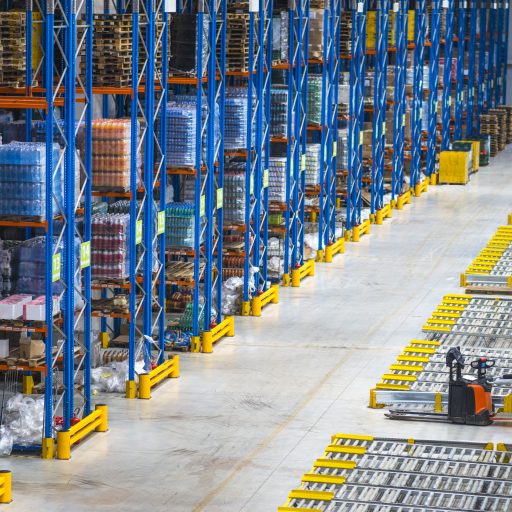
What is a Smart Warehouse and what are its advantages?
Share:
In recent years, logistics have changed completely. The ecommerce growth, the need to deliver orders faster and the management of an increasing volume of goods, have brought to light the limitations of traditional warehouses.
To meet these new demands, the Smart Warehouse has been born, a model that combines automation, artificial intelligence and robots to radically transform the logistics sector.
Why Smart Warehouse revolutionize the logistics sector
The Smart Warehouse represents a revolution within the logistics sector. It is a solution that overcomes some of the main limitations of the traditional warehousing system. A Smart Warehouse is a logistics facility where the majority of its processes are automated through the integration of technologies such as IoT, Big Data, robotics and artificial intelligence, among others.
Its main difference from a conventional warehouse is that decisions no longer depend entirely on human intervention. Thanks to sensors, connected devices and smart platforms, the system collects real time information which redefines the way of managing the warehouse.
But we mustn’t forget that a Smart Warehouse doesn’t intend to replace people with machines, but optimize its operations and significantly reduce errors. In this regard, in a Smart Warehouse, people shift their focus to tasks with higher added value, such as process oversight or innovation. Meanwhile, other tasks that are more repetitive or physically demanding are handled by automated systems.
Smart Warehouse technologies
We mentioned earlier some of the technologies that make a warehouse smart. Now, we want to take a closer look at some of its components:
- Warehouse management system software (WMS). It’s the brain of the warehouse. It centralizes all the information, coordinates the different processes, and enables the other systems to communicate with each other.
- Artificial intelligence. Thanks to AI, systems can learn from data to perform their functions, including making informed decisions and anticipating errors.
- Big Data. With the support of Big Data, large amounts of information from sensors, orders, inventory or logistics movements can be collected and processed to detect patterns and optimize performance.
- RFID (Radio-Frequency Identification) technology. It replaces the traditional barcodes. Thanks to radio-frequency tags, multiple products can be identified simultaneously and without direct contact, streamlining goods receiving and inventory control.
- Robotics. Autonomous mobile robots (AMRs), automated guided vehicles (AGVs), robotic arms, and automated storage and retrieval systems (AS/RS) take on tasks such as internal transportation, storage, and order picking. In this episode of HoM: Humano o Máquina, Darío Samaniego, CEO of SynergyTech, an official distributor of advanced robotics (Unitree), explained a real-world case that is already being implemented in many warehouses.
Is it worth having a Smart Warehouse?
The growing adoption of this model seems to answer the question by itself. According to Mordor Intelligence, the global warehouse automation market is expected to reach $41.8 billion by 2028. In addition, according to McKinsey, automated warehouses are doubling order fulfillment capacity.
But what benefits can it offer?
- Greater order accuracy and reliability, by reducing human errors.
- Increased productivity, by automating repetitive tasks and optimizing workflows.
- Greater workplace safety, by reducing human intervention in high-risk operations or tasks involving heavy loads.
- Reduced operating costs, thanks to time savings, fewer errors, and better use of resources.
- Space optimization, using algorithms that automatically assign the best location for each product.
- Adaptability, by responding quickly to changes in demand or order volumes.
To better understand how it works and why it is worth considering, let’s look at a real-life scenario as an example. Imagine that a truck arrives at the warehouse with a new order. As soon as the goods enter the warehouse, RFID tags identify everything that has been received almost instantly. The WMS cross-checks this information against the purchase order and immediately detects any discrepancies. It then selects the most optimal location for each product, and an autonomous robot transports the load to the corresponding location. Meanwhile, the inventory is updated automatically, and any manager can check stock levels in real time.
In short, Smart Warehouses have become a strategic asset for companies looking for more efficient and accurate logistics. Although their implementation requires a significant initial investment, the medium- and long-term benefits make it worthwhile. In addition, the emergence of modular and scalable solutions means that smart warehousing is no longer exclusive to large companies. Today, small and medium-sized businesses can also take their first steps toward a more connected, automated, and competitive warehouse.